How to Manage Social Media at Scale: Systems, Structure, and When to Outsource

Anne-Sophie Blais


Anne-Sophie Blais
There’s a moment most businesses eventually hit when social media stops feeling simple.
For some, it happens during growth: the company is expanding, new products are launching, the team is scaling, and suddenly there’s less time than ever to keep up with posting.
For others, it happens much earlier: the business is just getting started, everything is new, and social media quickly becomes one more responsibility on an already overwhelming list, with no clear direction on where to even begin.
Different starting points, same reality: social media becomes harder to manage consistently as soon as it has to support a real business.
And that’s the shift most people underestimate.
Because managing personal or small-scale socials is one thing. But social media at scale, for a business that needs to show up consistently, strategically, and with quality, is a completely different operating challenge.
It’s no longer about “posting when you can.” It becomes about building a system that can reliably produce, approve, and distribute content without breaking down every time priorities shift.
At scale, social media is not just communication. It becomes part of the business infrastructure.
And with that comes pressure that personal accounts never face:
Because what works for small-scale posting doesn’t hold up when social media management for companies becomes a core marketing function.

When social media becomes inconsistent, it’s rarely a content problem. It’s a system problem.
Most teams don’t lack ideas. They lack the structure required to execute those ideas consistently under real operational pressure.
Typical scaling symptoms include:
At this point, your brand may still be active online, but it’s fragmented. And that inconsistency compounds over time, weakening clarity, recognition, and trust.
This is the first signal that scaling social media marketing requires more than effort, it requires a system.
To understand how social media at scale really works, it helps to look at what a functioning system actually includes.
This is how we operate as an agency when we structure managed social media services for clients.
This is where we start. Through an initial meeting, we make sure we truly get the essence of our client, and agree on :
Then we move on to setting exactly how the content will get produced regularly.
Once we know what has to be done and when, all that’s left is to create it. We then set on producing the :
Most teams fail not because they lack strategy, but because they only operate at the execution layer. That’s why things collapse as soon as volume increases.
A true social media workflow for teams isn’t about adding complexity, it’s about removing friction.
A working system that makes social media possible even during scaling typically includes:
This is what a truly efficient social media content calendar process looks like in practice: not reactive scrambling, but a predictable production system with built-in flexibility.


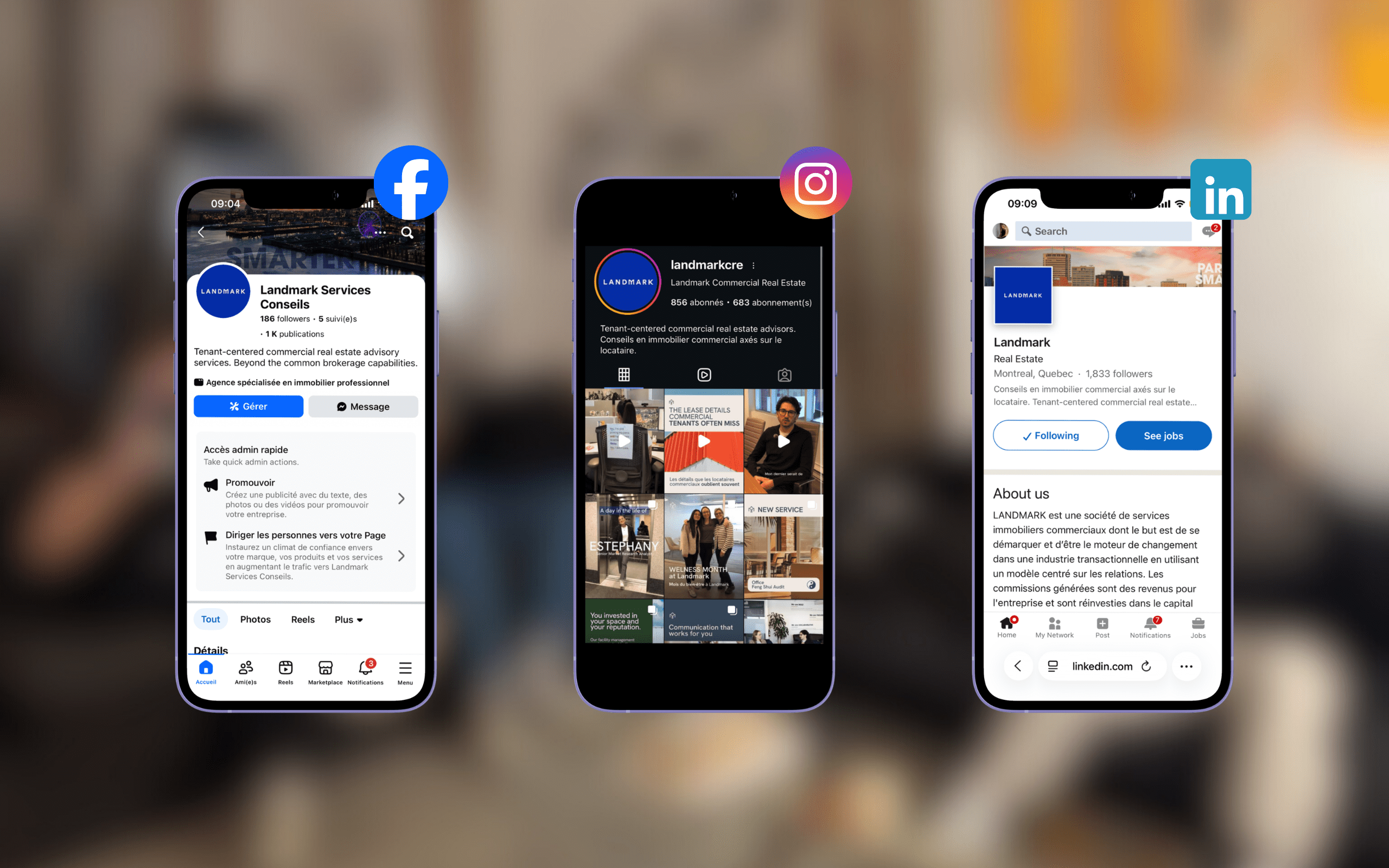
Here is a concrete example of the impact that effective social media management can have on a business. Before working with us, our client Landmark had neither a foundational structure nor a clearly defined content production process, which resulted in an inconsistent online presence (see first image). Through our support and the implementation of a structured workflow, their online identity has become significantly stronger, more cohesive, and more consistent (see second image).
There’s a persistent belief that strong social media is built on reacting quickly: jumping on trends, news, and cultural moments.
But in reality, reactive content without structure often creates more problems than it solves:
And while it can work sometimes, it often arrives too late to fully benefit from the moment.
This is why streamline social media marketing systems prioritize planning first.
Reactive content still has a place, but it should support the system, not replace it.
Without structure, you’re not building momentum. You’re just responding.
And over time, that becomes social media burnout business territory: constant urgency, no compounding value.
In today’s environment, not showing up consistently on social media is not neutral.
It has consequences.
When a business lacks presence, or posts inconsistently in either quality or timing, it often leads to:
And importantly, inconsistency doesn’t just affect perception: it affects performance.
Because reactive content is not a sustainable strategy. It doesn’t build compounding visibility, and it rarely supports long-term enterprise social media strategy goals.
At best, it fills gaps. At worst, it replaces structure with urgency.
If all of this sounds like a lot to keep track of, that’s because it is.
Managing social media at scale isn’t just another marketing task, it’s an operational system. It requires strategy, structure, production discipline, coordination, and consistency over time.
And most internal teams aren’t built to absorb that workload while also running the rest of the business.
That’s exactly why outsourcing your social media management is a great option.
Specialized partners (whether a social media management agency or outsourced social media marketing team) exist to turn this ongoing operational pressure into a structured, reliable system.
Not to replace your strategy. But to make execution sustainable.
When done properly, outsourcing allows you to:
In short: it turns social media from something you constantly chase into something that actively supports your growth.
Most teams don’t make the switch randomly. They do it when friction becomes constant.
Common signals include:
If several of these feel familiar, the issue is likely structural, not creative.
And that’s usually the point where social media team structure and external support become not just helpful, but necessary.
At scale, social media stops being about “keeping up” and becomes about infrastructure.
Some companies build that infrastructure internally. Others rely on partners who specialize in building and maintaining it.
The goal is the same either way: a system that keeps your brand consistent without urgency, burnout, or last-minute scrambling.
Because once that system exists, your social media stops feeling like something you’re constantly behind on.
It becomes something that moves your business forward, predictably, and at scale.
If you’re at the point where social media feels harder to manage consistently in-house, we can help you build the structure and systems needed to scale it without losing clarity or control.